The Bitcoin Paradox: Why Satoshi's Silence Matters More Than His Name
The hunt for Satoshi Nakamoto is back in vogue, with high-profile projects reigniting the decades-old speculation around Bitcoin’s anonymous creator. We've seen a 2024 HBO documentary point fingers at Peter Todd, while a recent New York Times investigation made a case for Adam Back. Both have issued denials, and frankly, the cycle feels familiar. The instinct is to read this as a renewed obsession with identity, but that misses the real point.
Here's the thing: the actual story isn't about *who* Satoshi is. It's about *what he could do* with the estimated 1.1 million BTC still sitting untouched in wallets attributed to him. That’s roughly 5% of Bitcoin’s entire supply, holding immense power over a cryptocurrency ecosystem now valued at $1.4 trillion. This isn't just academic; it’s a latent market force, and it’s why the question of Satoshi’s existence continues to cast such a long shadow.
The Community Speaks: Identity Fatigue, Economic Alert
If you ask the broader tech community, a clear sentiment emerges: identity fatigue has set in. A recent HackerNoon poll asked whether people still care who Satoshi Nakamoto is. The results are striking. A combined 73% of respondents essentially shrugged, stating either that Bitcoin has long outgrown its creator or that they'd never really cared in the first place.
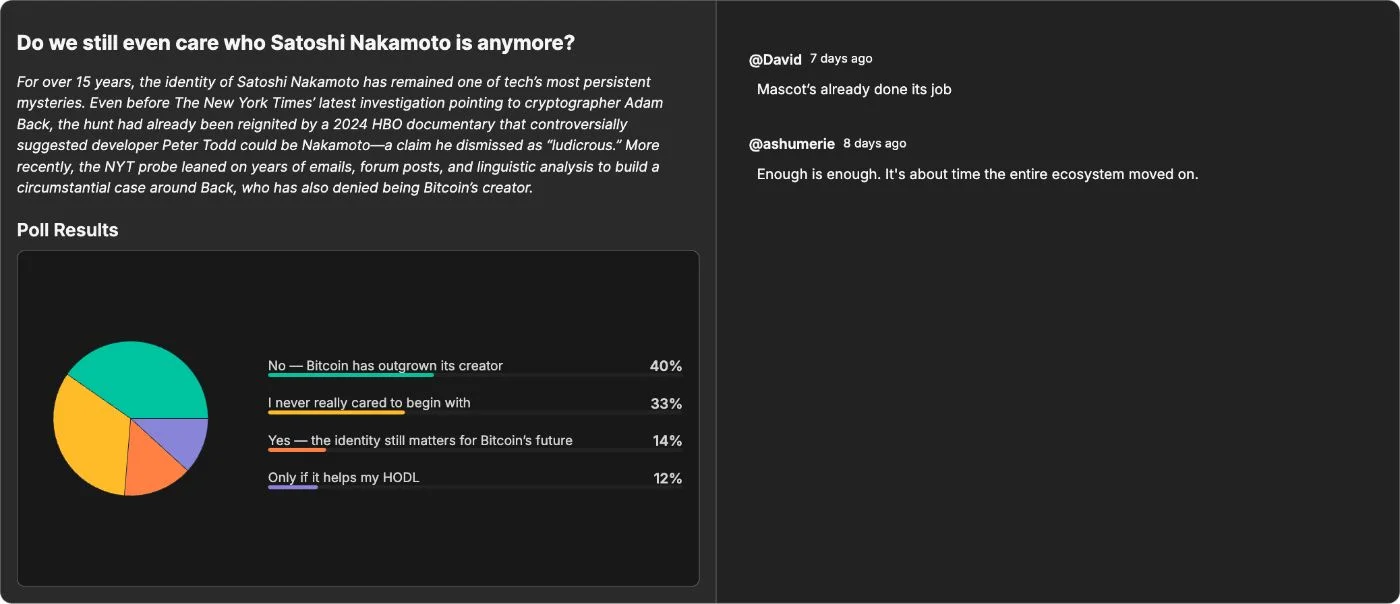
This tells us something important. For most, Bitcoin's integrity and functionality as a decentralized network have superseded the mystique of its origin. Blocks are mined, transactions clear, and the system works as intended, independent of its genesis. That's the narrative that resonates. And yet, a significant minority holds a different view. Just 14% believe Satoshi’s identity still matters for Bitcoin’s future, but a notable 12% take a far more pragmatic stance: they’d only care if a revelation or action directly impacts their holdings. This last group, small as it is, points to the underlying tension in the Satoshi narrative.
You can weigh in on these poll results yourself.
The Dormant Giant: 1.1 Million BTC and the Fear of Movement
While the cultural narrative around Bitcoin may have outgrown its founder, the economic reality hasn't. Those 1.1 million BTC, sitting in wallets untouched for well over a decade, represent an unprecedented potential market shock. Think about it: 5% of all Bitcoin, moving suddenly. The sheer volume would dwarf typical exchange flows, triggering immediate and unpredictable price reactions across the board.
It’s not just about a temporary dip or surge; it’s about the signal. Such a move would raise profound questions about Satoshi’s intentions. Is it a sell-off? A transfer? A reallocation? Any action would be instantly dissected, fueling speculation and potentially undermining market confidence in ways we haven’t truly seen. For an asset built on trust and a perceived scarcity, the sudden activation of such a massive, dormant supply from its creator introduces a level of uncertainty that no one wants to contend with.
Market Predictors Focus on Action, Not Identity
This is where the real-world sentiment gets fascinating. While journalists and documentarians chase the "who," serious traders and market participants are focused squarely on the "what." Platforms like Polymarket and Kalshi, which function as prediction markets, illustrate this perfectly. They’re not betting on Satoshi’s identity; they’re betting on his wallets.
Polymarket, for instance, has an active market asking: "Will Satoshi move any Bitcoin in 2026?"
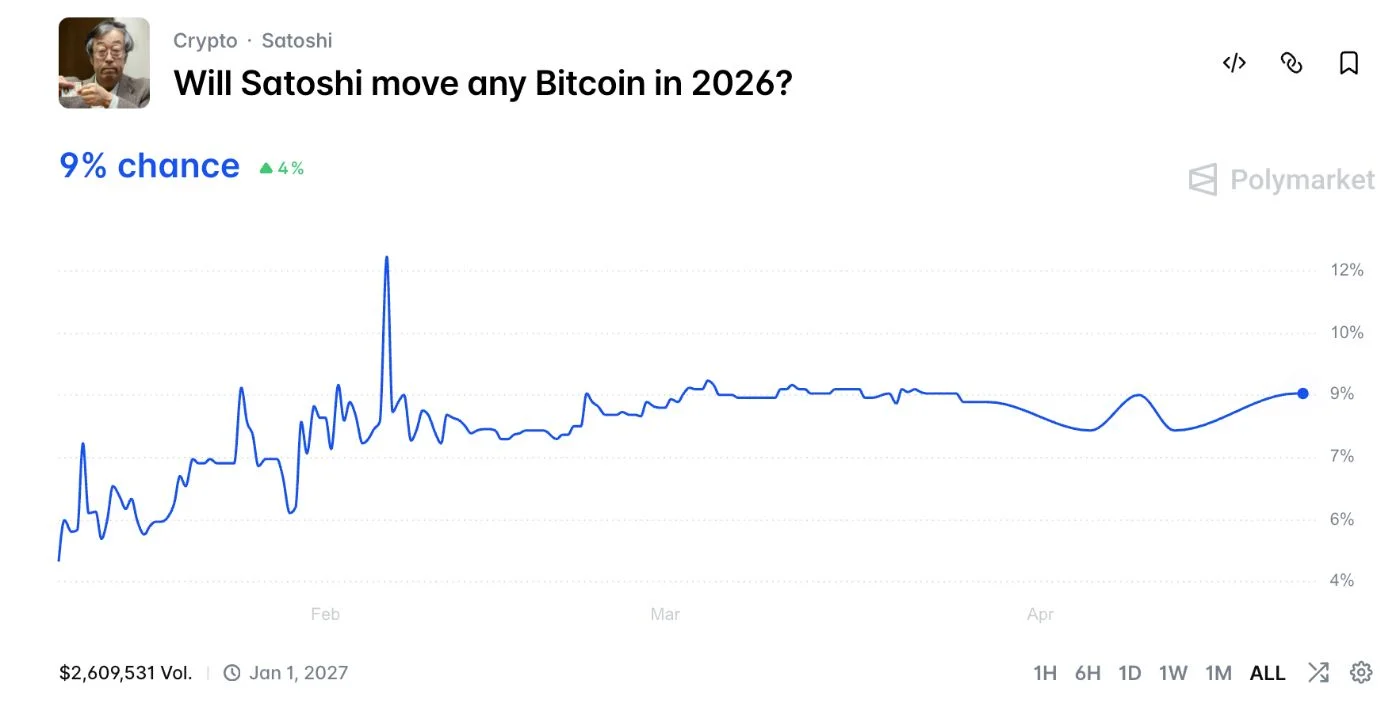
Current odds suggest traders don’t expect movement, leaning towards the wallets remaining silent, much as they have since Bitcoin's early days. It’s a pragmatic view that acknowledges the historical pattern of non-action. Similarly, Kalshi poses a slightly different timeline: "Will Satoshi move any Bitcoin by next year?"
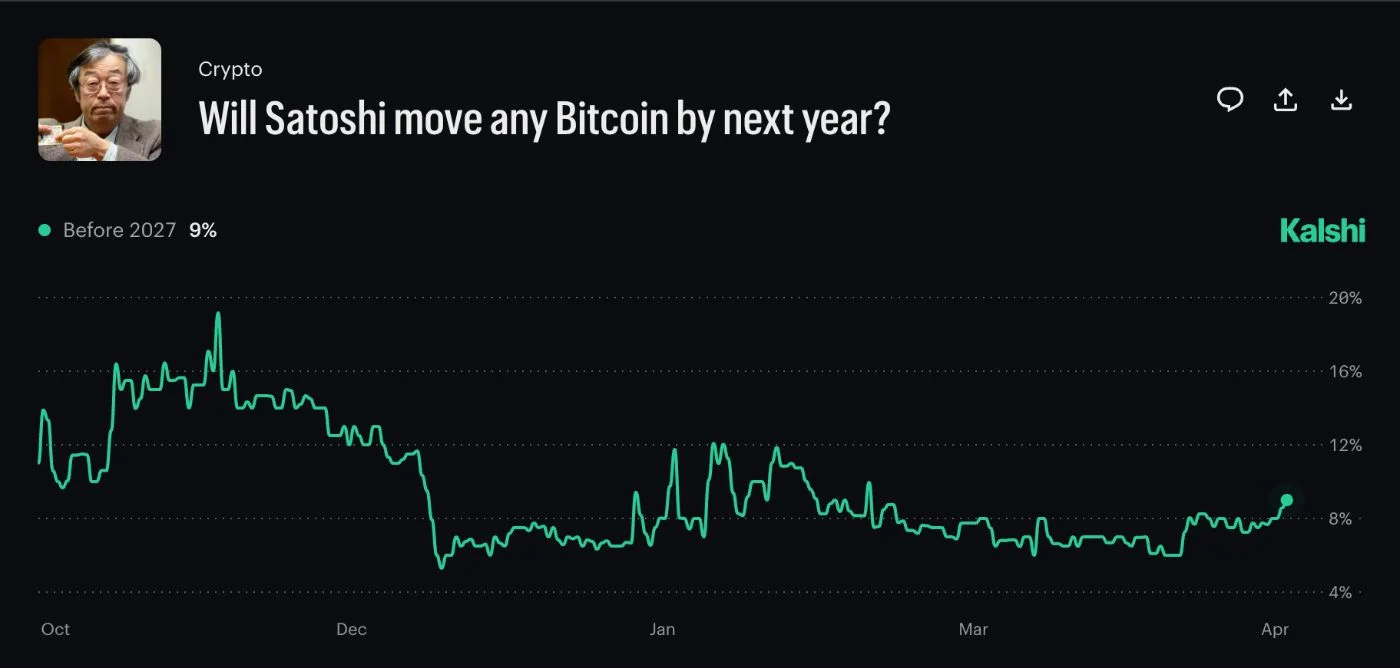
Again, the focus is purely on the action. These markets strip away the romanticism and media circus around identity, concentrating instead on the singular event that would truly impact the value proposition and stability of Bitcoin. The fact these markets even exist, and are actively traded, underscores the persistent, if quiet, concern among those with actual capital at stake.
Decentralization's Paradox: The Ghost in the Network
The existence of such a massive, concentrated, and dormant holding by an unknown entity presents an interesting paradox for Bitcoin's core ethos of decentralization. The ideal is a network where no single party holds undue influence. Yet, here we have 5% of the total supply controlled by someone whose identity, and therefore motives, remain opaque. It’s a ghost in the machine, a historical anomaly that the network has to live with.
The sustained silence of these wallets, while reassuring in its consistency, is also a constant reminder of this central vulnerability. It’s a testament to Bitcoin’s resilience that it has grown into a $1.4 trillion asset despite this Sword of Damocles hanging over it. This resilience isn't just about code; it's about the collective belief and distributed participation of millions who continue to build upon and secure the network, effectively outmaneuvering the potential individual influence of its creator.
The Watch Continues
So, do we care who Satoshi Nakamoto is? For most, perhaps not in the way the media narratives suggest. The intrigue of a secret identity has given way to a more mature understanding of Bitcoin as a self-sustaining system. But the potential movement of 1.1 million BTC from those ancient wallets? That's a different story entirely. That's a genuine market event, a test of the network's mettle, and a question that continues to occupy a quiet corner of every serious Bitcoin watcher's mind. The watch isn't for a name to appear; it's for a transaction to occur, or, more likely, to simply remain absent.