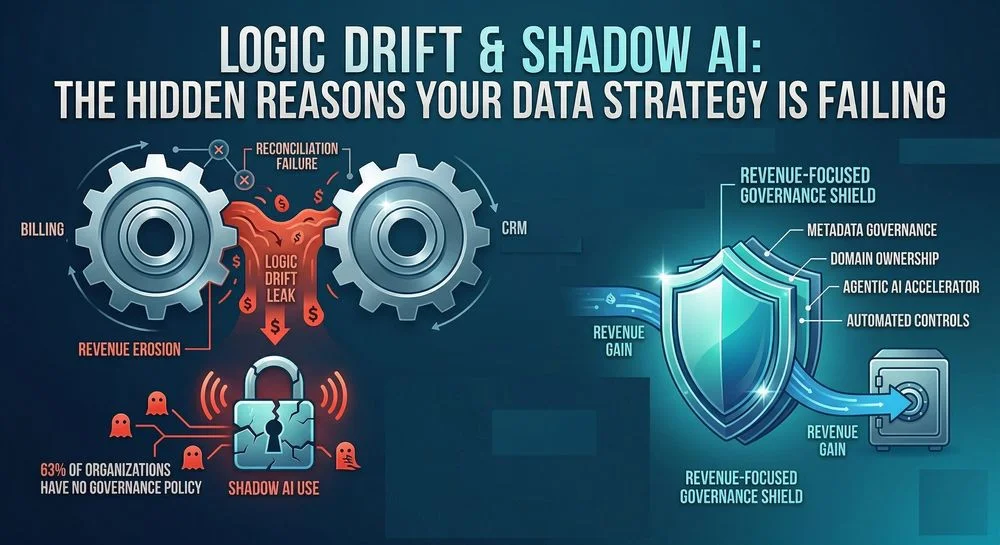
Logic Drift & Shadow AI: Overcoming Hidden Technical Debt in Data Strategy
·5 min read
When a data leak makes headlines, the typical boardroom reaction is often to classify it as a pure cybersecurity incident: a hacker got in, data got out, and now IT needs to clean up the mess. But, if you've spent any real time knee-deep in data operations or development, you know that read often misses the point entirely. The truth is, value bleeds out of an organization long before any data publicly leaks, often because of internal, systemic failures that have little to do with external threats.
This is the core argument of ebbenze's article, "Logic Drift & Shadow AI: The Hidden Reasons Your Data Strategy is Failing," published on . The piece doesn't pull punches, suggesting that this narrow focus on external cybersecurity is, in itself, a framing error. What we're actually looking at is a deep-seated systems design problem, not just a security one.
Beyond the Breach: The Real Culprits
The article highlights several internal issues that consistently undermine data strategy, causing what it terms "value leaks." These are the insidious cracks that form long before any external breach.
First up, there's **broken reconciliation**. Think about it: data from different systems often fails to align correctly. This isn't just an inconvenience; it means you're operating on inconsistent truths, making accurate reporting and decision-making nearly impossible. Then there's **drifting business logic**. What starts as a clear rule for data handling slowly morphs over time, often undocumented, leading to processes that no longer reflect current business needs or regulations. It's a silent killer for data integrity.
Equally problematic are **stale permissions**. User access rights, once granted, often aren't reviewed or revoked even as roles change or employees leave. This leaves an open door for unauthorized access, not by a hacker, but by an employee who simply shouldn't have it anymore.
And, of course, the elephant in the room: **Shadow AI**. Employees, seeking to be more efficient, frequently copy sensitive company data into unapproved generative AI tools. These platforms often lack the necessary security safeguards or data retention policies, creating enormous risk vectors outside of the IT department's control. It’s an easy trap to fall into, but it’s a direct threat to data governance.
This particular piece is a Community Article, meaning it's user-generated content and not formally reviewed by SitePoint, but its points resonate across the industry. It's published in the AI, Business, Database, and Security categories, underscoring its broad relevance. The takeaway here is crucial: if you're primarily focused on external cyber threats, you're missing half the battle. A truly robust data strategy demands a hard look at the internal design shortcomings that invite disaster.It’s time we broadened our definition of a data leak. For too long, the conversation has fixated on external attackers, breaches, and the dramatic headlines that follow. But what we're seeing now, and what’s increasingly clear, is that some of the most damaging and costly data exposures aren't "hacks" at all. They’re internal failures of control, integrity, and discipline that silently erode revenue and trust, often without a single attacker in sight.
The core issue? Organizations haven’t fully grasped that data isn’t just a business asset to be leveraged; it’s an engineering responsibility that demands rigorous, consistent management. When the rules governing critical functions like entitlements, billing, or access start diverging across different systems, you're looking at a vulnerability that can feel as catastrophic as a breach, even if no external party ever gains entry. Similarly, giving employees free rein with public AI tools outside of approved channels is like inviting sensitive information to walk right out the door, often undetected until the damage is already done. We need less abstract boardroom discussion and a lot more focus on the specific technical patterns creating these quiet exposures.
When Control Collapses: The Multi-Million Dollar Question
The idea that breaches are an inevitability isn't new. Every CEO has to ask whether their company's architecture and operational rigor can withstand one. The real gut check, though, is recognizing how quickly engineering missteps — technical debt, lax controls, or unchecked logic — escape the development sandbox. They don't stay confined to IT; they bleed directly into revenue, shatter customer trust, and ultimately deflate enterprise value.
Equifax offers a chilling reminder of this. Back in 2017, attackers exploited a known vulnerability, a simple unpatched software flaw, to expose the personal data of over 147 million people. That incident became a definitive case study: a seemingly ordinary engineering oversight, left unresolved, escalated into an extraordinary business catastrophe. It’s hard to imagine a clearer example of how technical debt directly translates to financial and reputational devastation.
And Equifax wasn't an isolated incident. We've seen variations of the same story play out at T-Mobile, Marriott, and more recently, Marks & Spencer. The pattern is consistent: once internal controls fail, the costs stretch far beyond the initial incident. While the visible event might be a cyberattack or a ransomware demand, the root cause is frequently far more mundane—unpatched systems, poor visibility into data flows, fragmented ownership of data, or sensitive information moving through environments no one is actively governing.
The Silent Killers: Logic Drift and Shadow AI
Many of the most expensive failures don't involve an outside attacker at all. These incidents originate internally and often lack the dramatic flair of a cyberattack, making them harder to spot in real-time. IBM’s recent analysis highlights one rapidly expanding category: Shadow AI. This occurs when employees upload sensitive company or customer data directly into unauthorized AI tools, completely bypassing established security and governance protocols.
From an engineering perspective, Shadow AI isn't just a policy infraction; it's an uncontrolled pathway for data egress. The problem isn't the use of AI itself, but rather that these ad-hoc data paths circumvent critical safeguards: logging, redaction, data retention policies, access controls, and crucial vendor reviews. Once that happens, teams lose all ability to answer fundamental technical questions: What information departed? Who sent it? Was it masked? Is it still retained? Can access to it be revoked? The lack of answers here is a business liability.
Then there’s "logic drift," the insidious, slow divergence of business rules across systems that are assumed to be in agreement. I've personally seen cases where, for example, Salesforce would not reconcile accurately against actual billing data in SAP. Customer entitlements were being interpreted differently across regions and various downstream processes. At first glance, nothing appeared broken; there was no outage, no attacker. But this silent mismatch gnawed at the bottom line for multiple quarters, ultimately costing the organization over $100 million once the full scope of the damage was finally quantified.
Logic drift matters profoundly to developers precisely because it often originates as seemingly minor implementation details: a formula re-coded slightly differently in a new service, a data transformation adjusted during a historical data migration, a field reused with a subtly altered meaning, or a dashboard metric that no longer precisely matches its source system. Over time, these small discrepancies compound, leading to flawed reporting, incorrect entitlements, significant revenue leakage, and critical business decisions based on corrupted assumptions.
Developers: Your Role in Catching Silent Leaks
The challenging aspect of logic drift is its stealth. Each system, viewed in isolation, might appear entirely correct. The problem only surfaces when outputs are cross-referenced across the entire workflow. This makes detection an engineering discipline, not a one-off audit. A practical starting point is to treat business logic not as a buried implementation detail within each application, but as a shared contract that demands clear definition.
Here's how developers can get ahead of it:
* **Establish a Source of Truth:** Pin down a definitive source for critical calculations like entitlement status, billable state, renewal dates, pricing rules, and revenue recognition inputs.
* **Version Business Rules and Data Contracts:** Treat your business rules like code. Version them. This allows downstream services, data pipelines, and dashboards to validate against a single, canonical definition rather than each reinterpreting it locally.
* **Automate Reconciliation:** Implement automated jobs that regularly compare data between operational systems (like Salesforce) and analytical systems (your data warehouse or SAP). If discrepancies exceed a defined threshold, trigger alerts just as you would for any other production issue. For instance, a basic SQL reconciliation check could involve joining `CRM_Entitlements` and `ERP_Billing` tables on a `Global_Customer_ID`, comparing logical statuses (`is_active` vs. `is_paid`), and alerting if they diverge.
* **Implement Contract Tests:** Add contract tests around high-risk data transformations. When schemas, formulas, or data mappings change, validate the expected outputs before promoting that data downstream.
* **Maintain Auditable Snapshots:** Keep auditable snapshots of critical records. This enables teams to compare what a user should have had access to, what the billing system recorded, and what the analytics layer displayed at any given point in time.
This is where many data strategies falter. Teams meticulously monitor uptime, pipeline completion, and dashboard refreshes, yet they often overlook the fundamental question of whether the underlying logic still holds the same meaning across disparate systems. A "green" pipeline can, unfortunately, still be delivering entirely the wrong answers.
Taming Shadow AI Without Stifling Innovation
Shadow AI is often less a governance failing and more a design problem. Let's be blunt: if the officially sanctioned path for using AI is slower, more complex, or simply less effective than pasting data into a public chatbot, employees will find a way around policy. It’s on developers, data teams, and product designers to ensure the secure path is also the easiest and most appealing path.
* **Provide a Controlled Access Layer:** Implement an approved AI access layer or gateway. This ensures all prompts and data uploads flow through consistent logging, policy enforcement, redaction, and leverage only vendor-approved models. Think of it as: Developer -> Approved Gateway (Redaction / Logging) -> Enterprise LLM.
* **Automate Sensitive Data Detection:** Block or warn users when sensitive fields — account numbers, personal data, pricing terms, customer lists, or contract text — are about to leave controlled environments.
* **Treat AI as an Identity:** Apply the same rigor to AI agents as you do to human users. Utilize role-based access, service accounts, and scoped tokens. An AI assistant should never inherit broad, unrestricted access simply for convenience.
* **Isolate Experimentation:** Clearly separate development and experimentation from production environments. Developers should test models in sandboxes, while production data should always require approved connectors, masking rules, and full audit trails.
* **Log Everything:** For internal AI systems, ensure prompts, tool calls, and downstream actions are meticulously logged. This provides the necessary audit trail to investigate misuse, logic drift, or unexpected outputs after the fact.
The essential mindset shift here is straightforward: every AI-enabled workflow must be treated as another application surface. If a user interface, plugin, bot, or internal agent can read, transform, or export data, it deserves the same level of design scrutiny and security consideration as any other critical production system.
The Real Cost of Data Leaks (It’s More Than Just Fines)
Looking solely at regulatory fines or front-page headlines drastically understates the true cost of a data leak. The damage is layered and often delayed. Some costs are immediate: incident response, forensic analysis, customer notification, and direct remediation. But the insidious expenses arrive later: litigation, significant customer churn, extensive operational rework, a degraded brand reputation, and years of defensive spending that inevitably slow down product development and platform innovation.
Logic drift follows a similar trajectory. The first indicator might be minor: a dashboard discrepancy, a customer support escalation, a finance exception, or a dispute over a contract renewal. But once teams are forced to untangle months of incorrect logic across multiple applications, data pipelines, entitlement systems, and customer communications, the remediation costs skyrocket. What started as a "reporting issue" quickly morphs into a complex, cross-functional repair program.
This is why the traditional distinction between a "breach" and a "data integrity failure" matters far less than most people assume. From an engineering perspective, both represent critical control failures. In one scenario, the wrong party gained access to data. In the other, the system itself failed to preserve the intended meaning of that data. Either way, the business takes a substantial hit.
Reframing for Revenue Protection: A Path Forward
Terrifying as these failures appear, they are absolutely reducible with enhanced technical discipline. Drawing from direct experience recovering over $100 million in leaked revenue across various enterprises, here are five concrete steps leaders and technical teams can implement *today* without fundamentally altering the business's core mission:
* **Treat Critical Business Logic as Production Code:** Assign clear owners, version it, document it rigorously, and test it consistently whenever upstream or downstream systems change.
* **Dismantle Silos with Shared Controls:** Security, data engineering, finance systems, and analytics teams must reconcile against the *same* governed definitions, rather than each maintaining their own fragmented truths.
* **Treat AI as an Identity, Not a Feature:** Every internal bot, assistant, or AI agent requires scoped permissions, auditable activity logs, and revocable access, just like any human user.
* **Automate Controls for Shadow AI:** Policies are a start, but enforcement is paramount. Approved tooling, proactive redaction, robust egress controls, and continuous monitoring should be doing the heavy lifting to prevent unauthorized data movement.
* **Build Resilience for Both Breaches and Drift:** Teams need comprehensive runbooks not only for cyber incidents but also for reconciliation failures, entitlement errors, unexpected model outputs, and detailed plans for downstream rollbacks or data replays.
The boardroom that views data governance merely as a compliance checkbox has, frankly, already sealed its fate. True resilience isn't forged in the frantic aftermath of an incident. It's built through the quiet, often unglamorous engineering decisions made long before a crisis, when strategy still has the luxury of time and deliberate action. The real work of securing data, and protecting revenue, happens in those mundane moments of proactive discipline.